Tuesday, April 15, 2014

Very Basic Problems New Parents Face

Ms. Mimi is starting a serious of blogs to answer some of the very basic problems new parents face.

Soothe a Crying Baby the Montessori Way

Question from Her Pain is My Pain:

Hello, Ms. Mimi. 
I am a new parent and I am at a loss when my 8 month old cries over everything.  Some of my friends and family have said to pick her up every time while others advise that I let her cry it out.  Could it be that she is always hungry?  I simply don’t know what to do.  I feel like horrible for not knowing how to comfort my own child.  Please help!

Dear Her Pain is My Pain,
Great news!!  You are not alone.  Children are complex even in infancy, and when their only means of communication is crying, it can become overwhelming to both the child and the parent, but fret-not, there is light at the end of the tunnel.

Many parents believe that when a child cries it must mean they are hungry or in physical discomfort or pain, but that is not always the case.  Babies can cry for many reasons.  Maybe they’re scared, cold, hot, worried, bored, lonely, or they may simply be experiencing a sad or bad memory. 

So how do we soothe a crying baby the Montessori way?

Dr. Maria Montessori advise that we “follow the child”, in which case, it is important to spend time with your baby to learn what is being said with each cry.  Only with that will you understand how to meet your child’s needs.

In The Joyful Child, Michael Olaf states that a crying infant rarely requires food.  In fact, he wonders if babies were less soothed with food if that would alleviate the obesity problems we currently face.  He also states that it is the responsibility of attentive parents and caregivers to understand the cries of an infant so to better understand their sense of communication.

Here are a few guidelines to help with the process, as it will take some time to learn to differentiate the cries. 

- First, speak in a calm and gentle voice, reassuring her that you are present.
- If that doesn't work, make eye contact so to redirect her focus onto you.
- And if those don’t work, then check for physical pain or discomfort i.e. wet diaper, hungry, the need to be re positioned etc.

All children are different, and all children will have their own distinct cries to express their needs.   Be patient and be present.  You will learn to decode the cries and know that not all situations require immediate adult intervention.  It is important to watch for learning opportunities, and while it may be a bit irritating to the child, the space to work through their discomfort and gain independence and confidence in oneself is critical in their development.   

Ms Mimi Ha

Mimi Ha, winner of the 2013 Milpitas Post BestTeacher of the Year and Best Infant Program awards, has been working with young children for nearly a decade.  She has a Bachelor’s of Arts degree in Communicative Disorders and Sciences, Degree in Sociology and Liberal Arts. Ms. Mimi worked with various leading non-profit organizations that support children with Autism. Ms. Mimi Ha believes that children are the key to a brighter world and through them we can learn a great deal about ourselves.


Wednesday, April 9, 2014

MOMtessorian – a mother’s Journey for finding the right school (Montessori)

It’s my personal experience that I would like to share it with everyone. When I was pregnant with my son, Ethan, I had many dreams for him. Every day he grew in my belly was another moment spent day dreaming of who he will become. I was excited to show him the ropes and get him through the bumpy roads of life, but little did I know, he was going to take wheel and I was merely a guide, the GPS.

Most of the dreams I had for him were pretty typical, lift head by 3 months, crawl by 5 months, walk by 11 months, and talk by 12 months. He didn’t even pop out yet and I had his first year entirely planned out, all thanks to my piles of baby books and years of child hood education and experience under my belt. It wasn’t long before I started fantasizing about what school he will go to, what sports he will join, what college he will attend, the list goes on and on.

The big day came and my son was born. There he was, full of life, curiosity, and joy.And here I was a nervous wreck! One of the things I did to help calm myself was imagine all the goals I had planned for him, and think about how I work towards that.

Few months had passed, and now my son is 5 months old. He was strong enough to lift his head, but didn’t show signs of crawling anytime soon. I freaked out. “How come he isn’t crawling? I gotto do something about it” 

Through my research no longer as a student, or therapist, but now as a mom, I stumbled upon the Montessori Method. The more I learned about Montessori, the more intrigued I grew. I am not exactly sure what caught me, whether it wasthe deep respect teachers had for the children, or that the children were able to manipulate the materials and learn through their own experiences, or that the teachers followed each child as unique individuals! I saw my little Ethan in a different light. Instead of looking at him as a future Ivy League scholar, I saw him as a child full of wonder and mystery. I shifted my feelings away from who he was supposed to be based on my preconceived notions and accepted he will be who he is meant to be.

After having started my position as a teacher in the infant Community then Director in a Montessori School, I saw ALL children differently. Suddenly the parents who came to me with suggestions of “my child must read by 3 years old” seemed silly. But really, that was me not long ago. Asking Ethan, or any children, to conform to my ideals is like “Judging a fish by its ability to climb a tree, it will live its whole life believing that it is stupid.”-Albert Einstein.

When making the big decision of deciding Montessori or conventional schooling—it was natural for me to choose Montessori because “Montessori is an education for independence, preparing not just for school, but for life” –Maria Montessori. That was what I wanted for Ethan, to learn without fear of reprimand and freedom to explore individual interests while building up confidence. He is now a toddler; with much to say, do, and share. I let him take the wheel, and guided him to the destination of his journey.

Milinh Villanueva

 About Milinh Villanueva


I have been working with children since 2003, with ages ranging from 6 weeks through Kindergarten, and developmental abilities ranging from typically developing to special needs. I have a bachelor’s degree from San Jose State University reflecting special and childhood education. My Montessori certification is nearly completed with all coursework and I am eager to start practicum. Not only as a Director, but also as a mother of a child who attends Montessori school, I believe in the Montessori philosophy wholeheartedly. For me, the Montessori Method is more than just an approach to learning academics; it is the way to developing the child as a whole taking into account their physical, emotional, and social growth.


Wednesday, April 2, 2014

Behavior-> Time out, do they work

There's no doubt about it: Time-outs work?? Sort of………  


What is a time out?  Time-out is a term for a form of punishment that involves temporarily separating a child from an environment where inappropriate behavior has occurred, and is intended to decrease positive reinforcement of the behavior. It is an educational and parenting technique recommended by some pediatricians and developmental psychologists as an effective form of child discipline. Often a corner (hence the common term corner time) or a similar space where the child is to stand or sit during time-outs is designated.
Forms of “Time-Out” in the Preschool Classroom
• Sending a child to sit in a chair, alone, that is designated as the “time-out” chair
• Sending child to a table to sit alone during circle
• Sending child to sit somewhere alone on playground
They work because unless a child has become hardened and aloof, the experience of being separated from the group’s comforting presence is unpleasant at best and intolerable at worst. But they come at a price, and eventually they stop working — because they violate one of the three primary drives of a child's brain: the need for close and secure attachment.
Children need a secure attachment
Children are wired to be closely connected to their caretakers. Attachment is vital to their survival and well-being. Unlike the young of other mammals, little humans are utterly dependent on their guardians to provide food, warmth, shelter and nurturing. We simply cannot survive without being connected to those who care for us.
When a misbehaving child is sent “away” to "think about" their offense, the only thing they're really thinking about is either how soon they can get back to the group or how bored they actually might be. The former response is what we initially see in a younger child whose experience of anxiety at being separated from the group shoots through the roof. The latter response — Boredom!
Why time-outs don't work - The problems with time-outs are numerous. First, at the very time when the angry or misbehaving child is out of control and in need of the calming influence of a caring person, they're left to settle down entirely on their own. Most children are incapable of doing this. They need an adult to help them come back to themselves when they're swept up in the storm of their emotions. A child whose behavior has been so impulsive or destructive as to warrant being sent away shouldn't be left to his own devices to become centered again.

Sending a child away when they're distressed is essentially saying to them, "I can't handle you when you show this side of yourself. Come back when you can be the manageable Susie or Johnny that I can handle." Not only are we telling the child that we only find the good, compliant version of them acceptable, we're also declaring our inability to cope with all of who they are.
A child deeply needs their parent and teachers to function as the confident captain of the ship in their life. When a teacher sends a child away because they can't handle their misbehavior, they're effectively telling them that they (the child) have the power to render them (the teacher) incompetent and helpless.

Time-outs increase separation anxiety
One of the characteristics seen in children whose parents routinely use time-outs is clinginess. Unless (or until) these kids become hardened and indifferent, they handle separation badly. While it usually works to tell a child who refuses to leave the park, "OK, then, I’m leaving without you!" (Most kids will indeed come running), the anxiety created by chronically threatening a child with separation damages their core sense of security and connection.

What can you do?
When a teacher functions as the captain of the ship in their classroom, there's a natural dynamic at play that makes time-outs largely unnecessary. Sure, there are always times when our kids are moody, hungry, sleep deprived or running on empty, but if we do our best to anticipate problems before they manifest, we can usually avoid behavior getting out of hand.

For all practical purposes, time-outs are the equivalent of shunning a child. In most societies, shunning is considered the most dreadful form of punishment. When we instead manage a child's misbehavior while preserving their sense of connection with us, we avoid the harmful effects of time-outs — which in the long run, create more problems than they solve.

• Redirect – help child find something interesting to do
• Ask the child to help with an adult task – set up lunch, reset the shelves
• Help two children solve their issues – use peace education language – give them the language to use so they can start to solve problems on their own without the adult – very powerful
• Implement a Peace Table
• Have child “hold your pocket”
We will be discussing for one of the most effective ways of “Time out – Would you like to Hold my Pocket” in our next edition of the blog. Stay Tuned!!

Colleen Noll 
 Executive Director of Calaveras, Crescent and Main Street Montessori Schools all located in Milpitas, Ca. Colleen is a formally trained AMS Montessori Teacher and worked in Montessori Education since 1992. She personally oversees the 3 Montessori Schools, which serves Infants through Kindergarten age. For over 13 years, her Motto has been "Children First, Always".

Wednesday, March 12, 2014

SV Montessori Birthday Celebrations, Practical Life Teachings, Writing and Montessori toys

1.     Children Birthday Celebrations
·        Children love sharing the story of their life. Their special story is brought to life in a Montessori classroom, with the help of their parents.
Our teachers use some form of a sun, the written months, and a globe to help show the passage of time and the growth of the child from birth in this birthday celebration.

In preparation of this celebration, the parents of the birthday child are asked to make a poster with their child. Montessori Schools of Silicon Valley uses a special chart that Montessori child parents can pick up from the teacher in advance. The Montessori child holds the earth and begins their journey around the sun, marking each year with a brief story. This birthday celebration is very special and it is recommended that parents attend their child’s special circle. The poster is so sweet and allows the child to reflect on their favorite things and what they want to be when they grow up. It is a keeper!  We wonder who the scientist, zookeeper, and teacher will be.
A celebration is usually followed by a special snack. All the above can be discussed with the lead teacher in-charge.

2.     Practical Life Example
·        Practical Life Exercises are a very important component to a Montessori program.  Each of the exercises helps a child to develop her coordination so that she can later work with more academic materials. These activities help a child to gradually lengthen the time she spends concentrating and focusing. No higher learning can happen without focus and attention. Children love Practical Life because they can imitate the work of the adult. Children want to extend this work into their own homes. Allow your children to help fold laundry, organize their rooms, and dry dishes.  It will pay off in the future!
·        It has been said that babbling is to oral language development as scribbling is to written language development.

3.     Writing
·        There are so many factors which need to be in place before a child spontaneously writes words.  Scribbling is the initial stage in learning how to make the Shapes of letters.  Children's scribbles soon turn into lines and curves representing suns and people.  Invented letters and stories will emerge from their drawings.

In Montessori Education the children have access to curriculum which helps them on this long road to writing.  Besides developing control and concentration with the Practical Life Exercises, the three fundamental Materials which lead to writing and reading in the four to six year old children are the Sandpaper Letters, The Moveable Alphabet, and the Metal Insets.
4.     Holiday Toys
·        The holidays are a good time to share one of our favorite Montessori catalogs.
For Small Hands (forsmallhands.com) supplies homes and classrooms with well-made,child centered tools and toys. Setting up your home environment with your children in mind gives them opportunity fornot only independence, but as a means to contribute to family life. Let them help in the kitchen by peeling and chopping vegetables with some handy tools from For Small Hands.Delight young children with real tools that let them handle real tasks "all by myself!" Small Hands provides hard-to-find, child-size items allow them to pour their own juice or rake leaves by your side, purposeful "work" that supports self-confidence and independence. From a pitcher to fit small hands to open-ended games, toys, and crafts that call on spatial, motor, or problem-solving skills, they make sure every item provides an enriching opportunity.”

Thursday, February 20, 2014

History and Vision- Colleen Noll


Colleen Noll


When I opened Calaveras Montessori in 2001, I had already taken over another school and sold it, started a school in San Jose with a partner and already had eight years under my belt as a Program Director for 6 Montessori schools in San Jose.  I ran Calaveras Montessori until 2009 working in the children’s garden, the very place I hope to return when I retire.  I will tell you about my experiences in the garden later.  Whether or not I own one small school or 6 large schools, my vision is the same – “Children First, Always”

Our Vision – Our schools are a community where people take personal responsibility are truthful and treat others as they would like to be treated.  Schools where children have a deep respect for one another, are open to change and new opportunities, children who think for themselves, work together and continue to think and grow outside of the box. Children who cooperate and can find passion and happiness in what they do.  Teachers who love children, love working with children and who have made the Montessori classroom their passion and commitment. Teachers who continue to learn and grow using the work of Dr. Montessori, working together for the common vision of the school.  Everyone thinks of the child first, always. A school where parents slow down and enjoy their child, meet them where they are and appreciate the person they are developing into.  Allowing them to learn at their own pace and guide them to be compassionate and understanding people.

Our Mission Statement
It was around the year 2001, I was driving in my car in San Jose, and I had been operating my teachers college teaching young teachers the Montessori Method. I had also taken over a school in Milpitas that was on the brink of being shut down by state licensing.  After about 3 months of working on the floor of the classrooms and turning the school back around, it hit me - “Children First, Always”. It became crystal clear to me as I sat at a stop light. If we always consider what would be best for the children, we will never go wrong. It is now 2014 and I still live by the mission statement.  Although I still believe I have much to learn and hope that I will always have the open mind to grow professionally and personally, I stick to this statement. I allow my staff and enrolled families’ full permission to let me know if there is ever a time in any of my schools that this mission is not being followed.

Monday, February 3, 2014

The Road to Writing and Reading in a Montessori Class

The Montessori environment is rich in language. Whether through conversation or language games the young child is surrounded by vocabulary. Dr. Montessori's approach to teaching children to write and read phonetically is nothing short of brilliance, and should have long ago become a basic element in every early childhood classroom around the world.

At our schools we use a phonetic approach to writing and reading. Phonics is a method of teaching reading and writing by developing the ability to hear and identify sounds of the English language.Montessori believes that writing comes before reading. While writing is the thought of the children reading is a skill to interpret the thoughts of others.
Writing is a developmental process for children.  While babbling signifies development towards oral language, scribbling can be looked at as the first steps to writing.
                                                             
SV Montessori Writing and Reading
              

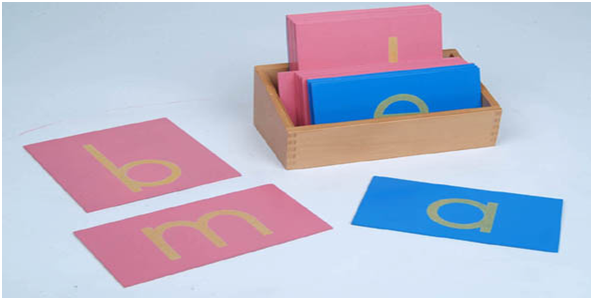
In a Montessori classroom children learn the sounds of the alphabet with the sandpaper letters.Beginning around age 3.5 Montessori children are introduced to a few letters at a time, until they have mastered a good portion of the alphabet. Using the sandpaper letter they trace the sound, as it would be written. They see, they feel, they hear the sound being pronounced.The shape of the letter becomes part of their muscular memory. Montessori children learn through touch and not memorization.

Dr. Montessori found that children were capable of encoding words months before they developed the hand eye coordination needed to control a pencil.Words are built using the movable alphabet using objects or pictures representing cat, bug, mat, etc.The child will sound out the letter and begin to build the words.They will naturally write larger words that don’t have a phonetic spelling as they increase their work and interest in this area.                       


Children then begin to compose words with the movable alphabet, they build words one letter at a time. Children increase the level of difficulty and can correct themselves.Children learn not to be afraid of making mistakes. Mistakes are natural steps in the learning process. The teachers facilitate, coach, and assist the child to correct own self. Being able to correct your own mistakes is far more rewarding, meaningful and leads to a confident, independent and self- assured person.

During the time children compose words with the Moveable Alphabet they are practicing concentration and body control with the Practical Life and Sensorial Materials. Letters are being written in sand, with chalk and even water against chalkboards.These materials allow for practice without the frustration of writing on paper with an eraser. They are then introduced to the Metal Insets, whichoffers practice in pencil control, lightness of touch, as well as design qualities. 


It is these three materials, Sandpaper Letters, Moveable Alphabet, and the Metal Insets, which are the core of the handwriting and word building curriculum for the three and four year old.

Reading skills normally develop so smoothly in Montessori classrooms that children tend to "explode into reading."They often begin to read back their own writing, their own thoughts, and then soon enough they are sounding out the words of others.Material is available to the children that focus on phonetic skills. Cards are organized to teach skills from short vowel to long vowel patterns, and more difficult work. Montessori teachers are trained to teach the young children parts of speech in very meaningful and interactive ways. One favorite work in the class is reading of action words (verbs). Children can read and perform actions like, jump, eat, dust, and mop. Soon enough they are diagraming sentences and understanding the ‘job’ of each word in a sentence.sThe children will naturally expand these new skills to interpret the world around them


Tuesday, January 28, 2014

Montessori Schools of Silicon Valley Focus on Nutrition

Providing healthy and nutrition meals for the children in our schools is important to us! Breakfast, morning and afternoon snacks are provided​. Water is always available for the children throughout the day. We also offer a school catered lunch option for an additional fee.
Our nutritious and tasty snacks include:
  • A large variety of fresh fruits and vegetables
  • Whole grain breads, crackers, muffins, etc.
  • Organic products (when available)
We never serve anything that would be considered:
  • sugary
  • artificial
If you chose to order the school catered lunch the following is included:
  • ​Entree (3-4 options daily to select from)​
  • Milk
  • Fresh Fruit
SV Montessori Menu

In the Montessori classroom we place our focus on the development of the "whole child". In order for children to have the energy and focus they need to learn and grow they must be provided with a nutritious diet and plenty of adequate physical activity. Having a proper diet and plenty of exercise plays a huge role in the physical, emotional and mental health of the child.
Along with providing the children with nutritional snacks also comes the experience they gain from trying new foods and preparing snacks independently. Through this we are encouraging the development of a healthy lifestyle and eating habits. We take great pride in not only providing the children with healthy snacks but also educating the children about where food comes from, the importance of limiting food waste and also how to respect their body by making healthy choices when selecting their food. By introducing the children to new and healthy food options at an early age, we are also are excited to prepare the child to make healthy eating choices, not just for now but for a lifetime.
The education part of our nutrition program takes place throughout our entire day with the children. In the morning and afternoon work periods the children enjoy snack preparation; they learn how to peel carrots and wash and cut fresh fruits and vegetables. During our cultural circle we have group discussions about exploring new foods and healthy food options. We also play fun and interactive group games, sing songs and provide Montessori jobs relating to the nutrition lessons for the children to use throughout the day. The more a child is exposed to a new food, the more likeable that food becomes to a child. The more "fun" they have learning about the food also reflects in the Childs willingness to try new foods. Another huge part in encouraging the children to make healthy choices is having the Teacher's as role models as well. By allowing the teachers to enjoy their very own healthy lunch and snacks with the children the concept of healthy eating is reinforced. ​
The physical development of the child is continuous throughout the day. Through movement circle, large motor activities, gardening and outdoor play the children are constantly engaged in physical activity. Many of the activities in the classroom allow the children to use their whole body which helps to develop their large motor skills along with teaching a concept such as "large vs. small" or "long vs. short". By using movement in the classroom children are also more apt to leaning these concepts through muscle memory. This is very different from a "Traditional" preschool environment where the children are generally confined to a chair and desk for the majority of the day.
Page Content
​
PageFooter

"Children First, Always"